- 000 – Police for immediate safety
- 13 11 14 – Lifeline
- 1800- RESPECT (1800- 737 732) family violence and sexual assault 24- hour telephone support

Why we exist
Stepfamilies Australia
First families have family trees. Blended families have forests.
We all know it’s easy to get lost in the woods, and to not see the forest for the trees. Re-partnering, settling into new routines, and bringing up kids between several households can bring a lot of difficulties. But it also brings a lot of positives, and stepfamilies can form strong, healthy bonds and raise healthy, happy children.
But who doesn’t love a forest?
The relationships within stepfamilies can be every bit as meaningful, impactful and loving as those within first families. In fact, the unique structure of stepfamilies can make them deeper and more impactful. Research shows that children thrive when an adult outside their biological family takes an interest in their life.
The things which make stepfamilies struggle are the same things which make biological families struggle. The major difference is that stepfamilies often face stigma. This isn’t an issue with the family structure, it’s an issue of how people respond to it.
That stigma can run deep. The word “stepfamily” is often framed as a deficit. It makes us think of the evil stepmother, the absentee stepfather. But if we zoom out for a moment, and describe it neutrally, then a stepfamily is just a family where at least one parent is not genetically related to all of the children. That’s it. Notice how there’s no focus on the relationship breakdown, or comparison to an idealised family. By framing stepfamilies in terms of what they are, rather than how they were formed, we can meet people where they’re at and deliver better outcomes.
It’s something new
Step and blended families require a lot of communication. Although this is true of every family, it’s especially pronounced in stepfamilies as everybody’s roles have to be actively negotiated. Biological families have well known scripts to follow, as they’re assumed to be the norm. But these can create problems for both biological and blended families. Not every member of a blended family needs to like each other, and not every child needs a stepparent to parent or discipline them.
The need for communication isn’t a downside, either. Blended families offer everyone involved a chance to find something which works for them, not an idealised family, or all families.
That’s pretty special.
Blended families face difficulties that first families do not
They are a vulnerable form of family, facing difficulties including:
- Complex relationship dynamics and different structures from nuclear families
- A sense of shame and embarrassment, making it difficult to talk publicly
- Stigma and a lack of community understanding, creating social isolation
- Limited availability of targeted, specialist support
- Insufficient social policy to address the needs of stepfamilies
Stepfamilies Australia aims to fill this gap by providing early, preventative intervention. We take a public health approach, aiming to work with stepfamilies before issues arise, and before family breakdown.
What a lack of intervention costs
Members of stepfamilies, particularly children, experience higher risk factors for mental health problems compared to people in nuclear families. An absence of a father in childhood; family violence and disharmony; marital discord between parents; experiences of rejection; school transitions and divorce and family breakup are all contributing factors (Commonwealth Dept of Health & Ageing 2000: A Monograph). Children and young people suffer when their caregivers cannot make the new family work.
1 in 5 children and young people will grow up in stepfamilies (survey of family research by Pryor and Rodgers, Children in Changing Families: Life after parental separation, Blackwell, 2001) and one in 3 marriages is now a remarriage, with half of stepfamily couples not marrying (ABS). Considering this, it is worth noting that:
- 76% of homeless teens come from step and sole parent families (Chamberlain and MacKenzie)
- Stepfamily breakdown rates are twice those of first families – (AIFS research)
- If parents don’t cope well with family breakdown, children face higher risk of conduct disorder, depression, substance use, adamic difficulties and negative self-concept (Michaels, 2006).
The negative impacts are not limited to children, however. Research indicates that repartnered adults experience greater work-related, physical health and mental health difficulties than do adults in first marriages. This both leads to, and is impacted by, the cycle of separation. Rates of separation in remarriages are twice those of first marriages, which can further destabilise both caregivers and children. All up, family breakdown costs the community $3 billion per year (Commonwealth Parliament Committee report 1998).
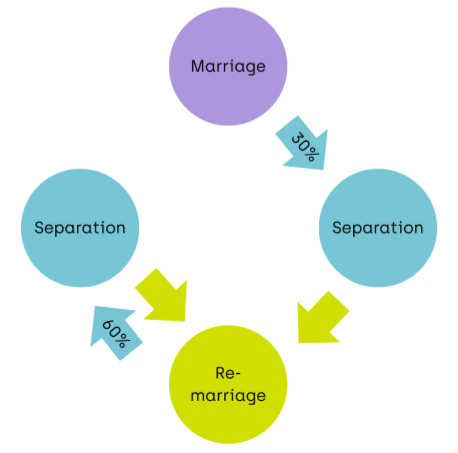 But it doesn’t need to be this way
For every risk factor, there are protective factors. Although being in a stepfamily poses some difficulties inherently, many stem from broader societal attitudes, and can be managed with sufficient support. There are things parents can do, and our goal is to connect people with the support they need to have a happy, healthy stepfamily.
| Risk Factor | Protective Factor |
|---|---|
| Family transitions and mobility | A sense of belonging or connectedness to family |
| Inappropriate family management | Feeling loved and respected |
| Family conflict | Proactive problem solving and minimal conflict during infancy |
| Family history of problematic alcohol or drug usage interfering with family rituals | Maintenance of family rituals |
| Harsh, coercive or inconsistent parenting | Warm relationship with at least one parent |
| Marital instability or conflict | Absence of divorce during adolescence |
| Favourable parental attitudes towards risk taking behaviours | A “good fit” between parents and child |
What we’re doing about it
Stepfamilies Australia works with stepfamilies to prevent issues as and before they arrive, rather than after the fact. We also train other professionals with the goal of creating a nationwide support network to support stepfamilies. The more awareness there is across systems, the fewer points of failure, and the less stigma on the whole.